Agile and Scrum: Understanding How Modern Software Teams Really Work
Introduction
Agile and Scrum are not just processes or meeting structures. They represent a shift in how teams think about building software, working together, and responding to change. Many teams say they are “doing Agile” or “using Scrum,” but true understanding comes from knowing why these ideas exist and how they connect in daily work.
This article explains the essence of Agile and the full Scrum framework in a clear, simple, and connected way, grounded in the Scrum Guide but easy to understand for anyone working in software.
The Idea Behind Agile
Agile was born out of frustration with rigid development models that planned everything upfront and struggled when requirements changed. Instead of treating change as a problem, Agile treats it as a reality.
At its heart, Agile is about:
- Delivering value in small, frequent steps
- Learning from real feedback
- Collaborating closely instead of working in silos
- Adapting as understanding improves
What Agile Values Emphasize
Agile is guided by four core values:
- People and communication over rigid processes or tools.
- Working software over heavy documentation.
- Customer collaboration over fixed contracts.
- Responding to change over sticking to an initial plan.
Scrum as a Practical Expression of Agile
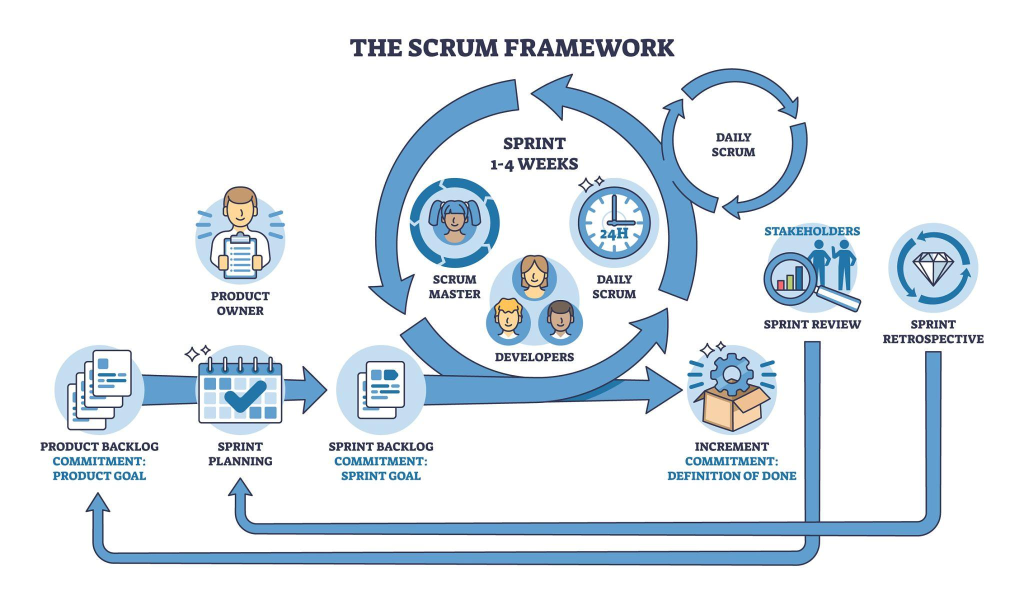
Scrum is a lightweight framework designed to help teams live Agile principles in a structured, repeatable way. It creates a clear environment for teamwork, transparency, and continuous improvement.
The Roles in Scrum
- The Product Owner: Represents value and manages the Product Backlog.
- The Scrum Master: Supports the process and removes obstacles.
- The Developers: Responsible for delivering the working software increment.
Scrum Artifacts
- Product Backlog: A living list of everything the product needs.
- Sprint Backlog: The plan for a single Sprint.
- The Increment: The working, tested result of the Sprint.
- Definition of Done: A shared agreement on the criteria for completion.
The Scrum Rhythm (Events)
- The Sprint: A fixed time box (1-4 weeks).
- Sprint Planning: Defining the "what" and "why" of the work.
- Daily Scrum: A short check-in for alignment.
- Sprint Review: Showing what was built and gathering feedback.
- Sprint Retrospective: Focusing on process improvement.
Transparency, Inspection, and Adaptation
Scrum is built on three key pillars:
- Transparency: Shared understanding of progress and challenges.
- Inspection: Regularly checking results against goals.
- Adaptation: Making changes when something is not working.
Conclusion
Agile provides direction, while Scrum provides structure. They shift focus from following plans to creating outcomes that matter. Agile and Scrum are about working smarter, learning continuously, and building software that delivers real value in an unpredictable world.